
AI Is Moving From Answers to Actions. What Happens Next?
By Sarah Lennon – 9 minute read
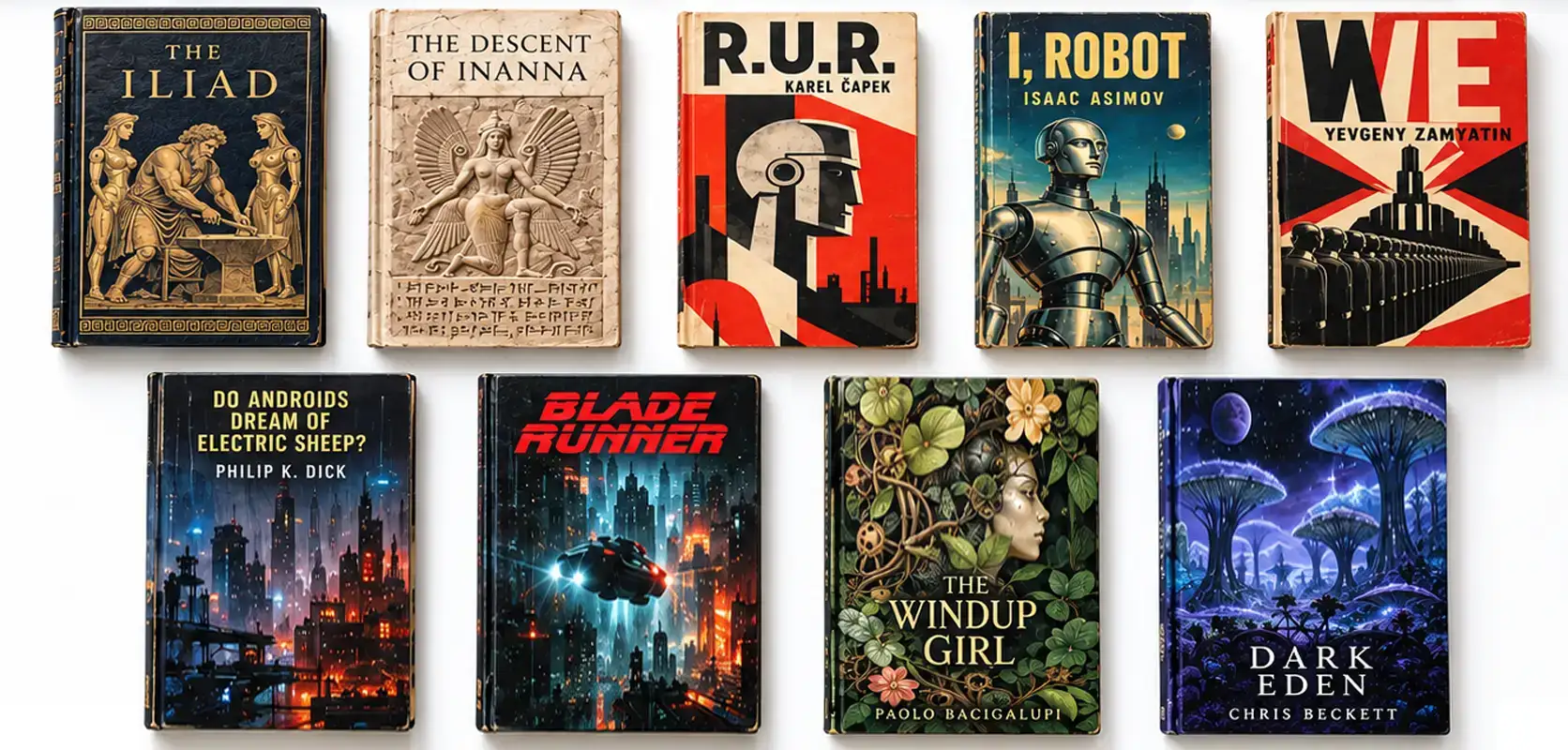
Long before computers, we imagined intelligent helpers. In The Iliad, Hephaestus is assisted by golden handmaids—not human servants, but artificial women forged from gold, with intelligence, strength and speech. In the ancient Sumerian story of Inanna, non-human beings are created to enter the underworld and complete a task humans cannot. Much later, Karel Čapek’s 1920 play R.U.R. gave us the word “robot” through a story about artificial workers. We have been returning to the same idea for thousands of years: something made rather than born, able to understand an instruction and act in the world. For most of that time, it was mythology or science fiction. It is now becoming an ordinary part of work.
I use AI every day across real creative and technical projects. It helps me research, develop articles, solve website problems, write and test code, create images, plan videos and work through business decisions. The increase in what one person can produce is already substantial. We do not need another broad explanation of how quickly AI has improved. We are living through it. The more important change is that AI is moving from answering questions to taking actions. Until recently, we asked AI to produce something and hand it back to us. Now we are beginning to give it an objective, access to the systems involved and permission to do the work itself. Instead of suggesting what should be changed, it can go behind the scenes and make the changes. OpenAI describes ChatGPT agent as a system that can research and take action across websites and connected sources. Anthropic uses a similarly practical definition: agents are language models using tools autonomously in a loop. The opportunity is obvious. So is the problem. AI is becoming more capable of acting with less direct supervision before it has become consistently dependable.
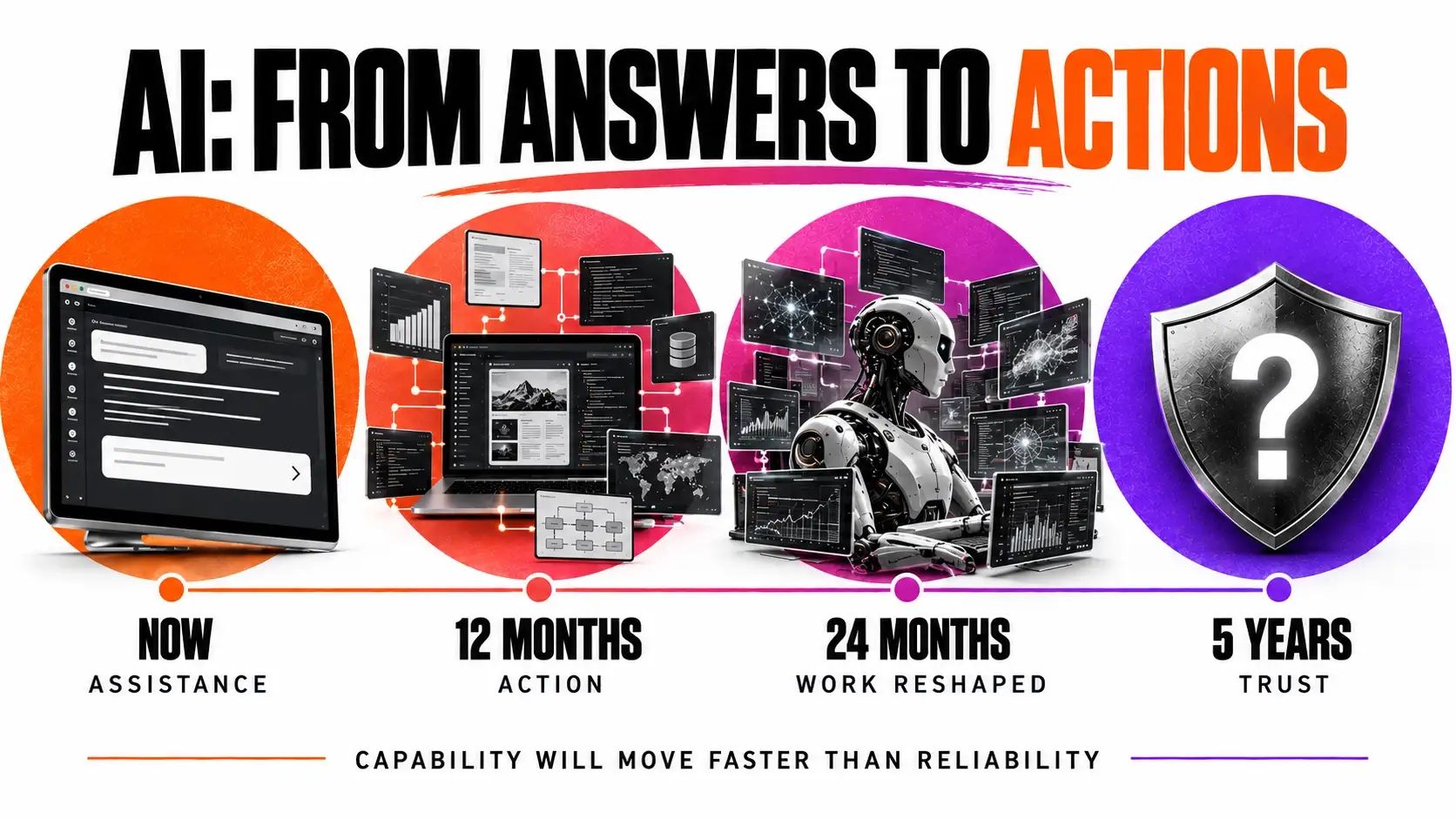
The next 12 months: AI stops merely answering
Over the next year, AI will become a much more useful working assistant. It will increasingly:
- Operate browsers and software: opening pages, entering information, moving between systems and carrying out the steps rather than telling us how.
- Work across documents, images, video, spreadsheets and websites: taking information from one place, changing it and putting it elsewhere.
- Retain more project context: remembering the client, the purpose, earlier decisions and the work already completed instead of being briefed again.
- Research a problem, produce a solution and revise it: investigating what is wrong, attempting a fix, testing the result and trying again when it fails.
- Build functional prototypes and competent basic websites in hours: turning a written idea into something a person can test on the same day.
- Stay with a task for longer without needing constant prompting.
For people already using AI seriously, this will not feel like the new arrival of one miraculous product. It will feel like the steady removal of friction. Tasks that currently involve repeated copying, prompting, checking and transferring between systems will become more continuous and autonomous. We will give AI an objective rather than asking it for one isolated output. But “more autonomous” does not mean “reliably finished.” I have already seen AI remove existing links after being explicitly instructed to preserve them, invent plausible URLs that did not exist, overlook requirements and then confidently tell me it had checked the completed work. These are not laboratory examples or amusing AI failures collected from social media. They happened during ordinary professional work, inside systems that were otherwise extremely useful. That creates the central problem of this next stage:
AI will increasingly look finished before it is actually correct.
Its language is confident. Its presentation is polished. A website can render correctly at first glance. A document can look complete. Code can run without immediately producing an error. None of those things proves the assignment was properly understood or completed. The companies building agents clearly know this. OpenAI’s agent asks for confirmation before consequential actions and can be interrupted by the user. Anthropic’s 2026 framework for trustworthy agents centres human control, transparency, privacy, security and alignment with what the user expects. Those safeguards are not decorations. They are evidence that the systems are useful enough to act and fallible enough to require limits.
The imbalance between development and oversight is difficult to ignore. A recent Private Eye “Number Crunching” comparison put the annual budgets of the UK’s AI Security Institute and the US Center for AI Standards and Innovation at £66 million and $55 million, against an estimated $2.6 trillion in annual AI spending—nearly 20,000 times the two public budgets combined. It is a deliberately blunt comparison, but the point lands: investment in making AI more capable vastly outweighs the money being spent on controlling it. That is the concern behind my earlier article, Why AI Leaders Want to Slow Down AI.
Isaac Asimov understood the shape of this problem when he formulated the Three Laws of Robotics. In simple terms:
- A robot must not harm a human or allow a human to be harmed.
- It must obey human orders unless doing so conflicts with the first law.
- It must protect itself unless that conflicts with the first two laws.
The Laws were fictional engineering rules designed to govern a machine’s behaviour. His stories then explored how apparently clear instructions could create ambiguity, conflict and unintended consequences. Modern AI is not an Asimov robot, and nobody has solved control by typing three rules into a prompt. The relevance is the underlying problem: an instruction that sounds clear to us may not produce the behaviour we intended. For Big Orange Planet, the productivity gain is real. We can investigate unfamiliar systems faster, develop and test solutions, create supporting content and move between technical and creative work with far less delay. I documented exactly what that looks like in What Actually Happens When I Build a Website With ChatGPT. AI still does not reliably determine whether the result serves the client, whether a design feels right, whether an apparent fix has created another problem or whether the work is genuinely complete. The humans at Big Orange Planet manage and control all of that. AI can feel like magic, but we are still the ones deciding what gets created and whether it is good enough. During the next 12 months, the winning model will be straightforward: give AI more of the production while keeping human control over the objective, the standard and the final check.
My 12-month prediction: AI’s ability to act will grow faster than our ability to trust it.
The next 24 months: AI starts swallowing parts of jobs
Within two years, I expect agents to handle bounded workflows lasting hours and, in some areas, considerably longer. They will research, build, test, revise and deliver useful work under human direction. They will not reliably run entire companies. They will not understand every client, exception or consequence. But they will absorb substantial pieces of jobs that are currently divided among several people. This is where the research becomes particularly interesting. METR measures AI capability partly by comparing the length of tasks an agent can complete with the time those tasks take skilled humans. Its original research found that the 50%-reliable task horizon of frontier systems had doubled roughly every seven months over a six-year period. Put simply, AI was not merely getting better at the same short task. The amount of work it could attempt before losing the thread or failing was repeatedly getting longer.
That does not mean we can confidently draw a straight line into the future. METR has published important cautions about the benchmark, task selection and the difficulty of measuring very high levels of reliability. Real business work is messier than a controlled software task. The direction is still hard to ignore. AI systems are completing longer, more connected sequences of work. Even if the pace slows substantially, two more years of progress will change what an individual and a small team can produce. The first major employment effect will probably not be the overnight disappearance of whole professions. It will be a change in how much labor is required to produce the same amount of work. We are likely to see:
- Fewer junior production roles in some digital fields.
- Smaller teams producing the output of much larger teams.
- Less money available for routine writing, stock design, basic coding and administrative coordination.
- Higher expectations placed on the people who remain.
- One capable person using AI competing with a conventional small team—something we have already witnessed at Big Orange Planet.
This is already beginning unevenly. The Stanford 2026 AI Index reports broad organizational adoption, while fully agentic deployment remains much less common. That is what an early transition looks like: widespread experimentation, real use in selected functions and a large gap between a demonstration and a dependable business process. The strongest near-term effect is therefore not “AI takes every job.” It is that AI takes pieces of many jobs, changing the economics around the people doing them. Karel Čapek’s R.U.R. is an unusually fitting reference. The robots in the play were artificial workers created to make production cheaper. A century later, the immediate business question is again labor: what happens when useful work can be produced at dramatically lower cost? The answer will depend on more than the software.
Many companies will discover that AI adoption is an organizational problem. An agent cannot safely operate a process the company itself does not understand. If responsibilities are unclear, information is scattered and nobody knows how completion should be verified, adding an agent will automate parts of the confusion. Businesses will need to define what good work looks like, where decisions belong, what a system may change and how important results are checked. This sounds less exciting than buying the newest AI platform. But it is where much of the real work will be.
What happens to web design?
Over the same two-year period, web design will separate into two very different markets. At the bottom, competent basic websites will become extremely inexpensive. A business that needs a standard five-page site will have access to AI systems capable of producing something visually respectable, technically functional and reasonably written with very little human labor. At the top, businesses will continue paying for positioning, custom functionality, unusual integrations, search authority, judgment and accountability. These projects are difficult because they involve competing requirements, imperfect systems, real customers, existing data and consequences when something fails. The comfortable middle—ordinary brochure websites assembled manually without a deeper strategic or technical reason for the work—will be squeezed hardest.
Our IDX Broker property-popup work is a useful example. AI helped us investigate the platform, develop and revise code, diagnose display problems, compare approaches and turn the experience into results. It increased the speed and range of what we could do. It did not independently understand what the client needed. It did not always recognize when an output was wrong. It could not decide whether the property listings felt coherent with the rest of the brand. This was not AI replacing expertise. It was AI multiplying expertise while still requiring somebody to direct and verify the work.
My 24-month prediction: AI will not swallow most professions whole. It will swallow enough tasks inside them to change team sizes, prices and expectations.
In five years: professional-looking proves almost nothing
Five-year forecasts should be treated cautiously. Timelines vary, technical progress is uneven and anybody describing 2031 with certainty is selling something. However, based on the present trajectory, it is reasonable to expect AI systems to conduct substantial computer-based projects under broad human direction. A person may set an objective, supply access and constraints, review important decisions and receive a largely completed body of work later. That projection is not mine alone. METR’s research on the growing length of tasks AI can complete says that, if the measured trend continues, we could see “AI agents that can independently complete a large fraction of software tasks that currently take humans days or weeks” within the next decade. METR is careful to call this an extrapolation rather than a certainty, but five years sits well inside the period serious researchers are now examining.
That does not require consciousness or human intelligence in every respect. It requires systems that are capable enough across long sequences of ordinary digital tasks to be economically disruptive. Routine digital production could become abundant: writing, imagery, video, basic development, analysis and administration produced at a scale that previously required enormous human labor. In plain terms, people will spend less time producing every piece of the work themselves and more time telling AI what outcome is needed, spotting what it has misunderstood and taking responsibility when the result matters. Education will also have to adapt, because a polished essay or standard homework submission will offer little proof that a student understands the subject.
But the largest change may be to trust. Text, images, video, reviews, identities and apparent expertise will all become inexpensive to manufacture. A polished website, a confident article or a professional video will no longer provide much evidence that the person behind it has genuine experience. This is where Blade Runner and Philip K. Dick’s Do Androids Dream of Electric Sheep? feel newly relevant. Their enduring question is not merely whether machines can imitate people. It is how anyone distinguishes the authentic from the manufactured—and what happens when the distinction becomes uncertain. Our version will be less cinematic but extremely consequential. Was this review written by a customer? Did this photograph document a real project? Does this expert have first-hand knowledge? Is this person real? Did this company complete the work it claims to have completed?
When professional-looking becomes automatic, value moves toward what is harder to fabricate:
- Verifiable identity.
- First-hand experience.
- Original data and documented results.
- Reputation accumulated over time.
- Trusted brands and human relationships.
- Evidence that something happened outside the AI system.
This is why generic AI content is not a sustainable authority strategy. Thousands of businesses can generate competent articles about the same subject. Far fewer can show what occurred on a live project, explain the decisions, document the outcome and stand behind the conclusion. Our IDX lead-generation articles have value because they came from real work. We did not ask AI to produce ten generic tips for a better real-estate website. We worked inside an actual property-search system, identified what was technically controllable, tested changes and documented what fixed the problem. That is the difference between generated knowledge and earned knowledge.
Websites become authoritative digital records
Websites will remain important, but their role will extend beyond pages designed only for human visitors. A company website will increasingly act as its authoritative digital record: the structured source that search engines, AI assistants and automated agents use to understand the business before recommending it or acting for a customer. SEO, technical clarity, reviews, citations, brand mentions, demonstrated expertise and consistent business information will converge around one larger question: Can people and machines confidently determine that this business is real, capable and trustworthy? That is not a new shortcut called “AI SEO.” It is genuine authority made legible to humans and machines.
My five-year prediction: producing convincing digital material will become easy. Proving that it is true, original and based on real experience will become much more valuable.
We have imagined this before—but we have not lived it before
There is a long shelf of stories behind the current AI moment. Yevgeny Zamyatin’s We explored a society organized by mathematical control. Blade Runner asked us to look at identity and manufactured life. Paolo Bacigalupi’s The Windup Girl imagined engineered beings inside a world shaped by corporate power and ecological damage. Chris Beckett’s Dark Eden examined how a society builds truth from inherited stories when direct knowledge has been lost. These works are not technical forecasts. Their value is that they give us older, larger questions to ask about new technology: Who gives the instructions? Who benefits from the labor? Who is responsible for the result? How do we recognize what is real? The technology is new. Those questions are not.
What I think happens next
I do not think the next five years will feel like one clean “AI revolution.” They will feel like a series of increasingly short shocks. Each time businesses become accustomed to one level of capability, the systems will acquire another: seeing, reasoning, operating software and completing longer bodies of work with less supervision. For creative and technical businesses, the sensible response is practical: Use AI aggressively where it accelerates good work. Understand where it fails. Verify anything consequential. Document genuine experience. Keep responsibility with the people who understand the client and the result. The prediction I feel most confident making is this: AI capability will improve faster than reliability, responsibility and trust. That gap will create the largest opportunities—and the most important problems—of the next five years.
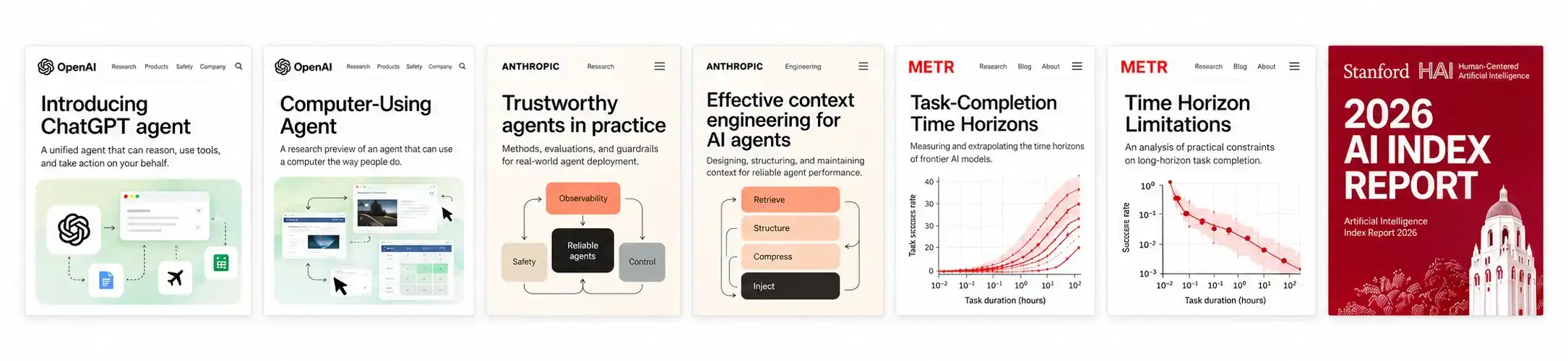
Sources and further reading – Current AI capability and reliability
- OpenAI: Introducing ChatGPT agent
- OpenAI: Computer-Using Agent—capability, mistakes and risk
- Anthropic: Trustworthy agents in practice
- Anthropic: Effective context engineering for AI agents
- METR: Task-Completion Time Horizons of Frontier AI Models
- METR: Limitations of the time-horizon measurements
- Stanford HAI: 2026 AI Index Report
Myth, literature and science fiction
- Hephaestus and the golden handmaids in The Iliad
- The Descent of Inanna—Electronic Text Corpus of Sumerian Literature
- R.U.R. by Karel Čapek
- I, Robot and Asimov’s Three Laws
- We by Yevgeny Zamyatin
- Do Androids Dream of Electric Sheep? by Philip K. Dick
- Blade Runner
- The Windup Girl by Paolo Bacigalupi
- Dark Eden by Chris Beckett

About Sarah Lennon
Sarah Lennon is co-owner and lead designer at Big Orange Planet, a Denver web design and SEO company. For more than 20 years, she has worked across web design, interactive experiences and digital strategy, exploring how design and functionality work together — from ecommerce and property search systems to interactive tools, animation and immersive brand experiences. She now works daily with AI as part of the real-world creative and development process. She writes from that hands-on experience, exploring where AI genuinely improves creative and technical work, where it falls short, and what happens when you actually put these tools to work on live projects.
Get the Good Stuff
No fluff. Just practical web design ideas, SEO insight, behind-the-scenes projects, & solutions we've tested in the real world.
Never Miss a Good Idea
More Big Orange Knowledge

How AI Is Transforming Web Design
Discover how AI is revolutionizing web design — from smart automation and…

Why Most Website Projects Fail Before Anyone Writes Code
Most website projects don’t fail because of bad code. They fail much earlier,…

Google Business Profile Optimization for Denver Companies
A strong Google Business Profile can make a major difference in local search.…

What Should Every Small Business Website Include?
A small business website doesn’t need to be complicated, but it does need to…

How Much Does Web Design Cost in Denver (2026 Pricing Guide)
Web design prices can range from a few thousand dollars to well into five…

Best Web Design Companies in Colorado: What to Look For
Google search results are shifting across industries, keyword clusters, and…