
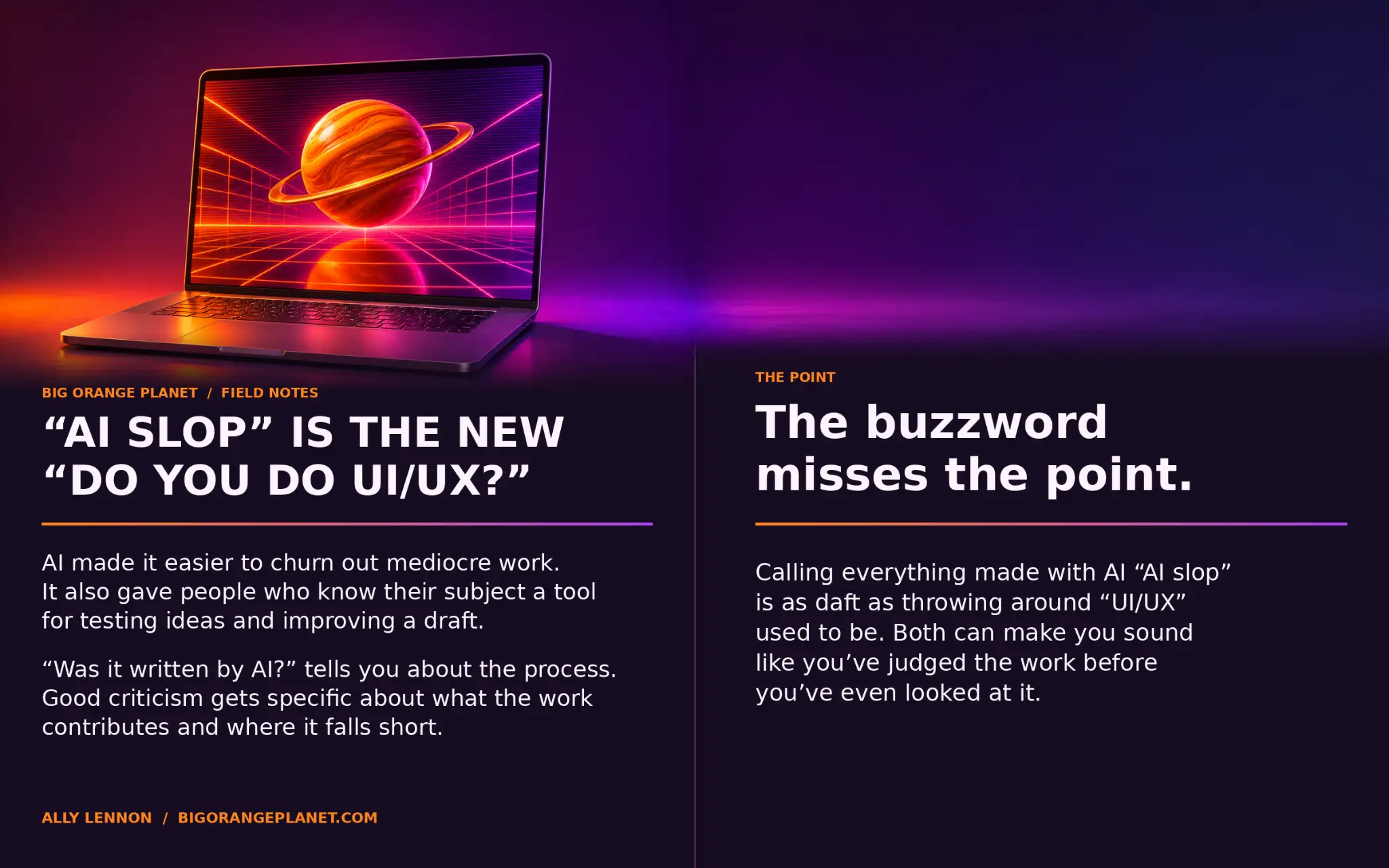
“AI Slop” Is the New “Do You Do UI/UX?”
We’ve reached the point where the quickest way to dismiss something you don’t like is to call it AI slop. It doesn’t matter whether the article is well researched, whether the argument is original, whether the author understands the subject, or whether the finished work is actually useful. If AI had a hand in producing it, that’s all some people need to know. It’s a remarkably convenient shortcut. You don’t have to challenge the argument, examine the evidence, or explain what’s wrong with the work. You just apply a label and move on, having established, at least in your own mind, that you’re discerning enough to recognize inferior content. There’s a problem with that approach. It doesn’t actually require you to recognize quality at all.
Let’s get something out of the way. AI slop is real. The internet is filling up with generic, repetitive, poorly researched material that has been generated, published, and forgotten without anyone putting much thought into it. We’ve all seen it. Articles that run for 1,500 words without saying anything particularly interesting. Websites filled with interchangeable explanations of subjects nobody bothered to understand. Content that sounds authoritative until you actually examine what it’s saying. There is plenty to criticize about that. But somewhere along the way, the criticism has expanded from identifying bad work to dismissing an entire category of work based on the tools used to produce it. That’s a much bigger problem than it might initially appear.
Using AI doesn’t make something AI slop any more than not using AI makes something good. That shouldn’t be a particularly difficult concept to understand. Yet the conversation increasingly revolves around whether AI was involved rather than whether the resulting work has any merit.
The New “But Do You Do UI/UX?”
There is something familiar about this particular argument. For years, one of the more predictable questions directed at web designers was, “But do you do UI/UX?” It was usually delivered with the confidence of someone who had just discovered two important industry terms and wanted to make sure you knew they knew them. There was nothing inherently wrong with asking about user interface or user experience. Both are important disciplines. The problem was that the question often became a substitute for discussing the actual website. Instead of evaluating the design, the architecture, the usability, the functionality, or the thinking behind the project, the conversation got reduced to whether the designer did UI/UX. It was a poor substitute for understanding what makes a website successful.
I’ve spent enough time in web design and development to recognize the difference between a question that leads somewhere useful and one that simply demonstrates familiarity with the vocabulary. A serious conversation about user experience involves understanding who the website serves, what visitors are trying to accomplish, where the design creates friction, and whether the finished product actually works. Asking whether someone “does UX/UI” without exploring any of those things tells you very little. Now we’ve got a newer version: “But was it written by AI?” Same basic exercise. Different terminology. Rather than evaluating the thinking, research, originality, accuracy, or quality of the finished work, someone reaches for a label that allows them to dismiss it without having to engage with any of those things. The old question was a way to sound knowledgeable about web design without necessarily understanding design. The new one is a way to sound discerning about writing without necessarily evaluating the writing.
Both are intellectual shortcuts dressed up as professional judgment. And here’s the particularly interesting part: the person making the accusation often has no idea how the work was actually produced. They don’t know how much research went into it, how many drafts were rejected, how many arguments were challenged, or how much editing took place. They simply assume that AI involvement tells them everything they need to know. If you can’t distinguish between thoughtful work that uses AI and generic material that was generated without thought, you’re not really evaluating the work. You’re evaluating your assumptions about the production process.
The Internet Didn’t Have a Quality Problem Invented by AI
Before generative AI became widely available, the internet was already full of terrible content. Businesses were publishing endless variations of the same blog posts. SEO agencies were producing keyword-stuffed articles with very little original insight. Websites were repeating information that could be found on a thousand other websites. Entire publishing strategies were built around producing more content rather than producing better content. Nobody needed ChatGPT to manufacture mediocrity. We had that covered. Some of the worst material I’ve encountered over the years was entirely human-written. It was researched poorly, structured badly, padded with unnecessary language, and published because someone had decided that having another article was more important than having something worth reading. A mediocre article doesn’t become insightful because someone spent three hours writing it. A recycled argument doesn’t become original because it was typed manually. A poorly researched website doesn’t become authoritative because its content was produced before AI existed.
The internet has never had a shortage of human-generated nonsense. AI has simply made it easier to produce more of it, faster. That is a legitimate criticism of the technology’s impact on publishing. It is not an argument that everything produced with its assistance is inherently inferior. There’s a fairly obvious double standard here. Human-produced mediocrity is often judged on its merits, while AI-assisted work increasingly gets judged on its method of production. Why should those standards be different? This is also part of a larger shift in how businesses establish credibility online. As discussed in why AI recommends some businesses over others, credibility is built through more than simply publishing information. Experience, consistency, and evidence matter.
The Tool Isn’t the Thinking
There is a legitimate distinction between using AI to improve your thinking and using AI to avoid thinking altogether. Someone who knows very little about a subject can ask an AI system to write an article about it. The result might be grammatically sound, reasonably organized, and convincing at first glance. It might even contain useful information. But without subject knowledge, independent research, and meaningful editorial oversight, the person publishing it has very little basis for knowing whether the result is any good. That’s a problem of competence and accountability, not simply the presence of AI. Now consider someone who knows a subject, has an argument to make, understands the audience, and uses AI throughout the development process. They might spend hours challenging assumptions, researching supporting evidence, rewriting sections, rejecting suggestions, restructuring arguments, and refining the finished piece. AI may have contributed words, suggested structure, or helped develop parts of the argument. But the human contribution isn’t measured by how many sentences were physically typed without assistance.
I’ve seen this distinction play out repeatedly in web development. Two people can have access to the same tools, the same frameworks, and the same technical resources, yet produce radically different results. One understands the problem, makes informed decisions, and knows when something isn’t working. The other knows how to operate the tools but lacks the judgment to use them effectively. The tools are available to both. The expertise isn’t. Writing with AI is not fundamentally different in that respect. Producing words and producing something worth reading have never been the same thing. A writer can produce thousands of words without contributing an original thought, while someone else can use AI as part of a much more involved process and produce something that genuinely advances a conversation. The difference isn’t necessarily the tool. It’s what the person brings to it.
When Everyone Can Produce Content, Content Isn’t the Advantage
For years, businesses, marketers, publishers, and SEO professionals have operated in an environment where producing content required time, resources, and some degree of specialized ability. The assumption was that producing more useful material could create an advantage. AI has changed the economics of that process. Content can now be generated at a scale that would have been impractical or prohibitively expensive just a few years ago. Businesses can produce articles, social posts, descriptions, reports, and marketing material with relatively little effort. But when everyone has access to the same basic production capabilities, production itself becomes less of a competitive advantage. The ability to generate an article doesn’t mean you have something worth saying. The ability to generate a hundred articles doesn’t mean you have a hundred worthwhile ideas. And publishing more information doesn’t automatically make a business more knowledgeable, more authoritative, or more useful to its audience.
This is where the conversation should be heading. Instead of asking whether AI was involved, we should be asking what the work contributes. Does it reflect actual experience? Does it introduce a useful perspective? Does it answer a question in a way that demonstrates understanding? Does it help someone make a better decision? Those are much harder things to manufacture. The irony is that as AI makes producing content easier, the value of original thinking, expertise, and editorial judgment becomes more apparent. A convincing explanation is not necessarily a substantiated one. A polished article is not necessarily an informed one. We should be getting better at recognizing those differences, not replacing them with a shortcut based on which tools were used. For a related perspective on the changing relationship between traditional search and AI, see what actually separates AI SEO from Google SEO. The technology changes, but the underlying need for useful information and credibility remains.
Original Thinking Is Becoming More Valuable, Not Less
When almost anyone can generate a plausible explanation of a complicated subject, the ability to distinguish a plausible explanation from a sound one becomes considerably more valuable. AI can assemble an argument, but it cannot automatically establish that the argument is correct. It can produce a convincing explanation without understanding the practical consequences of what it is describing. It can draw on existing information without necessarily recognizing what is missing, contradictory, or important. This is where experience and human judgment come into play. Original thinking isn’t simply about arranging words in combinations that haven’t appeared before. It’s about recognizing problems, making connections, questioning accepted assumptions, understanding context, and knowing when an apparently reasonable conclusion doesn’t hold up. It’s also about having something to contribute in the first place. A person with no particular knowledge, insight, or interest in a subject is unlikely to produce something especially meaningful simply by asking AI to write about it. The same person wouldn’t necessarily produce something meaningful by sitting down with a blank page and a keyboard. The tool isn’t the missing ingredient.
And this is why I think the AI slop argument often misses the more important conversation. We should be talking about the difference between information and insight, between producing content and contributing something, and between generating words and actually having something to say. Those distinctions existed long before AI. They matter even more now. That distinction also matters when considering how to make your business easier for AI to understand. The substance and clarity of the information available about a business matter far more than simply producing more material. There’s another side to this issue: having access to information doesn’t guarantee that someone knows how to interpret it or make good decisions with it. That’s explored in why smart people still make bad decisions. Intelligence, information, and sound judgment are not interchangeable.
The Responsibility Doesn’t Disappear
None of this means AI-assisted work should be exempt from criticism. Quite the opposite. If anything, the increased accessibility of these tools makes editorial responsibility more important. If you publish an inaccurate article, you’re responsible for it. If you publish something generic and unoriginal, you’re responsible for that too. You don’t get to blame the technology for failing to exercise judgment, just as you don’t get to claim the technology’s involvement makes the work inherently worthless. There are legitimate questions about transparency, intellectual ownership, authorship, and accountability. There are also legitimate concerns about businesses publishing material they don’t understand or making claims they cannot substantiate.
Those conversations deserve serious attention. But they are not advanced by pretending that the involvement of AI automatically invalidates the finished product. The responsibility remains with the person or organization putting the work into the world. The tool doesn’t take that responsibility away, and it doesn’t assume it on their behalf. Ultimately, the reader should be able to expect that what they’re reading has been considered, checked, and produced with some degree of care, regardless of how the words first appeared on the page. That responsibility becomes especially important when AI is interpreting information about real businesses. In what happens when AI gets your business wrong, we look at why accuracy and context matter just as much as visibility.
Maybe It’s Time to Evaluate the Work Again
AI slop is a real problem. But using the term as a blanket dismissal of anything AI-assisted is not a particularly sophisticated response to that problem. It’s the equivalent of asking a web designer whether they do UI/UX and assuming you’ve somehow evaluated their abilities by asking the question. If an article is bad, explain why it’s bad. If the thinking is shallow, demonstrate where it falls short. If the research is inaccurate, identify the errors. If the author has nothing original to contribute, make that case. Those are actual criticisms. They require some understanding of the subject and a willingness to engage with the work. Simply identifying the tool used to produce something is not the same as evaluating what was produced. We have more information, more publishing tools, more access to expertise, and more ways to produce and distribute ideas than ever before. Yet none of those capabilities automatically make us better at recognizing what is worthwhile. The ability to produce something and the ability to evaluate it are two entirely different skills.
AI has made the first considerably easier. It hasn’t made the second any less necessary. The ability to recognize quality should matter more than the ability to identify the tools used to produce it. And if the only way you can distinguish good writing from bad writing is by finding out whether AI was involved, perhaps the bigger problem isn’t the writing. It’s the evaluation. The old “Do you do UI/UX?” question didn’t tell us whether someone understood good design. The new “Was it written by AI?” question doesn’t tell us whether someone understands good writing. Both offer the comfort of sounding informed without requiring the effort of making an informed judgment. And that’s the real slop we should be worried about.

About Ally Lennon
Ally Lennon is the founder of Big Orange Planet, a Denver web design and SEO company. He builds websites, fixes the ones that aren't working, and has spent more than two decades developing SEO strategies that get businesses found online. He also spends an unreasonable amount of time figuring out what Google, AI and the rest of the internet are going to do next.
Get the Good Stuff
No fluff. Just practical web design ideas, SEO insight, behind-the-scenes projects, & solutions we've tested in the real world.
Never Miss a Good Idea
More Big Orange Knowledge

Your Router Says It Has “AI Security” — Do You Still Need a VPN in 2026?
Discover how AI is revolutionizing web design — from smart automation and…

AI Is Only as Good as the Person Who Knows When It’s Wrong
The most dangerous AI answer isn't the obviously wrong one. It's the plausible…

Why AI Recommends One Business Over Another
AI isn’t recommending businesses because they discovered some secret trick. The…

How to Make Your Business Easier for AI to Understand
Learn how to make your business easier for AI search systems to understand…

AI-Powered Ecommerce: Practical Strategies for More Traffic and Sales
Discover how AI is revolutionizing web design — from smart automation and…

When ChatGPT Lies About Its Own Work
ChatGPT told me it had preserved every link in a website content project. It…