
Why Google and ChatGPT Give Different Answers to the Same Question
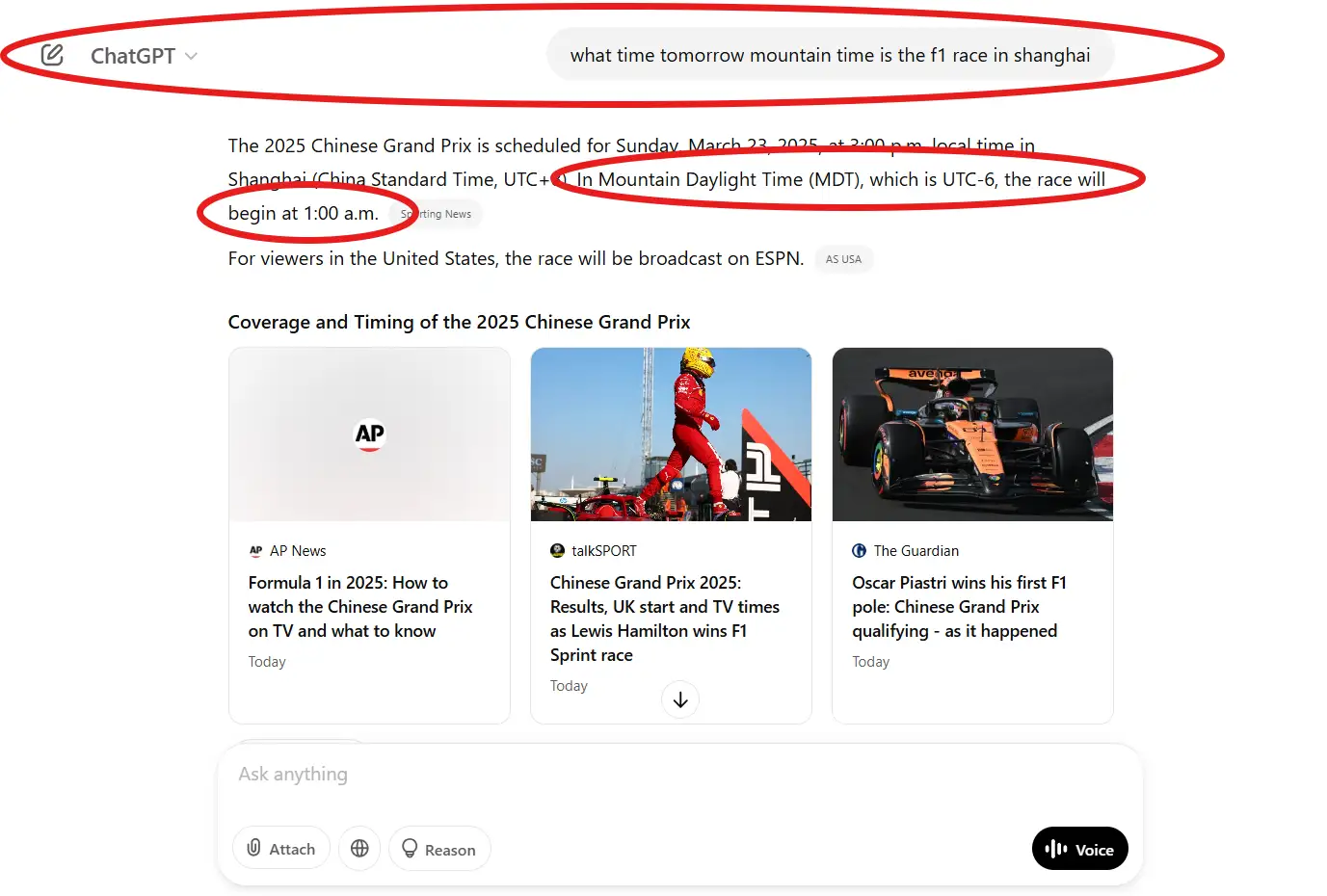
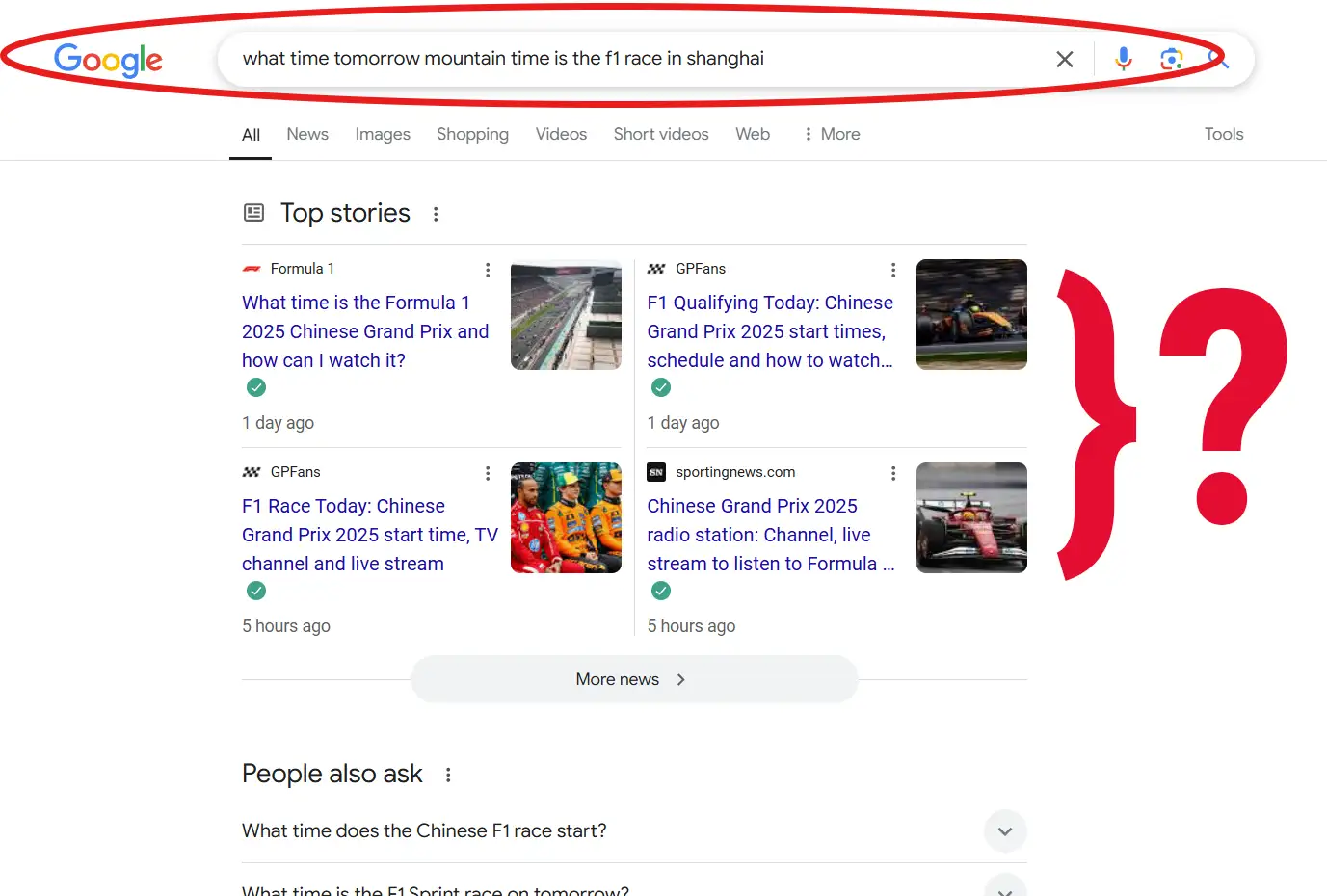
There is a very simple way to understand the difference between Google and ChatGPT: ask both of them the exact same question. I discovered this almost accidentally. I was trying to figure out what time I could watch an F1 race in Denver while the race itself was taking place in Shanghai. It was an ordinary question. I wasn’t researching a business, comparing products or looking for a dozen opinions. I simply wanted to know when I could watch the race. I asked ChatGPT. It gave me the answer I wanted.
Then I searched Google. Google gave me a collection of websites, articles, schedules and other information that I could use to figure out the answer myself. Neither result was necessarily wrong. In fact, Google was doing exactly what Google has traditionally done very well. It gave me access to information. ChatGPT did something different. It interpreted my question and gave me a direct answer.
That small difference is actually much more important than it first appears. Once you start comparing the two systems seriously, you notice that Google and ChatGPT aren’t really trying to do exactly the same thing. They may both be used when someone has a question, but the way they interpret the question, assemble information and present the result to the user is fundamentally different. And for anyone who owns a business website, cares about SEO or is trying to understand where search is heading, that distinction matters.
Google Gives You Results. AI Gives You an Answer.
For decades, the basic search experience has been remarkably familiar. You type something into Google. Google interprets the query, searches its enormous index, ranks the available information and presents you with a collection of results. You then make the next decision. Which result looks credible? Which headline actually answers my question? Should I click the first result? Is the second result better? Is this article current? Is this company legitimate? Should I compare several sources?
Google gives you the roads. You decide which road to take. AI systems can approach the same problem differently. Instead of simply presenting a list of possible destinations, an AI system can attempt to understand the question, synthesize information and give you something resembling a finished response. That changes the user’s role. When I searched for the F1 race time, Google essentially said, “Here are some places where you can find this information.” ChatGPT effectively said, “Here’s the information you’re looking for.”
That is a remarkably different experience. It doesn’t mean one is automatically better than the other. It depends entirely on what you’re trying to accomplish. If I want to know the start time of a race, I may prefer a direct answer. If I’m researching the history of Formula 1, comparing teams, checking several sources or trying to determine whether information is accurate, I may actually prefer the traditional search experience. The interesting part is that we are no longer choosing between “search” and “no search.” We are choosing between different ways of discovering information.
Then We Started Testing It With Businesses
At Big Orange Planet, we weren’t satisfied with simply noticing this difference in one F1 search. We started testing it. One of the more interesting experiments involved a straightforward question: “What are the top Denver web design companies?” When we searched Google, we received one collection of businesses. When we asked ChatGPT essentially the same question, we received a noticeably different collection.
That was fascinating because we know the Denver web design market. We know the businesses involved. We understand the local search landscape. We can see the differences between companies that have substantial search visibility, strong websites, established reputations and meaningful Google reviews and businesses that are considerably less visible through traditional search. Yet the AI response didn’t simply reproduce Google’s list.
That shouldn’t necessarily have been surprising, but it was revealing. If you assume ChatGPT is simply another interface sitting on top of Google’s search results, the difference seems strange. If you understand that AI systems can evaluate information differently and construct responses differently, the difference starts to make much more sense. And this is where the conversation about AI SEO becomes much more interesting.
Ranking Number One Doesn’t Mean Being Mentioned by AI
For years, businesses have been trained to think about visibility in fairly simple terms. You want to rank number one. If somebody searches “Denver web design,” you want your company at the top. If somebody searches “Denver SEO company,” you want your company at the top. If somebody searches for the product or service you provide, you want to appear prominently. That model still matters.
But AI introduces another question: What happens when somebody doesn’t ask Google to show them the best businesses, but instead asks an AI system to recommend one? Those aren’t necessarily the same thing. A business can have strong traditional search visibility and still fail to appear prominently in an AI-generated recommendation. Likewise, a business that doesn’t dominate Google’s organic results might occasionally appear in an AI answer.
That doesn’t mean Google is wrong. It doesn’t mean ChatGPT is wrong. It means the systems are solving somewhat different problems. Google has historically been exceptionally good at organizing and ranking information. AI systems are increasingly focused on interpreting information and constructing a response from it. Those activities overlap, but they aren’t identical.
That’s one reason we’ve spent so much time at Big Orange Planet looking at how to get your company mentioned in AI search results. The objective isn’t to find some secret phrase that forces an AI system to mention your company. The larger challenge is making your business sufficiently clear, credible and well represented that there is a reason for an AI system to consider you in the first place.
Search Is Moving From Keywords Toward Questions
There is another important difference hiding underneath all of this. Traditional SEO has historically been heavily influenced by keywords. Someone searches for “Denver web design.” You create a page about Denver web design. You optimize the title, headings, content, internal links and other signals around that subject. That still matters. But people don’t always communicate with AI systems in keyword fragments. They ask questions. They explain circumstances. They describe problems. They provide context.
Instead of searching Denver web design company, someone might ask, “I’m a small business owner in Denver and I need a new website. What should I look for in a web design company?” That’s a completely different type of interaction. The second question contains far more information about the user’s intent. It tells the system something about the person, the location, the problem and the decision they’re trying to make.
The answer isn’t necessarily going to be a list of websites. It may be an explanation. It may be a comparison. It may be a recommendation. It may include several businesses. It may include a mixture of all four. That means businesses increasingly have to think beyond individual keywords and start thinking about the questions surrounding their industry.
This is also why we’ve been looking more closely at how Google actually ranks websites in terms of meaning, intent, structure and evidence rather than simply counting keywords. A strong page doesn’t need to repeat the same phrase twenty times. It needs to make the subject clear enough that both people and machines can understand what the page is about and when it is relevant.
AI Doesn’t Eliminate SEO
This is where some of the early AI-search conversation went off the rails. There was a tendency to assume that AI would replace Google and therefore traditional SEO would become irrelevant. I don’t think that’s what we’re seeing.
The more we work with websites and AI visibility, the more obvious it becomes that the fundamentals still matter. A search engine or AI system still needs information. It still needs to determine whether information is relevant. It still needs to distinguish between credible information and nonsense. It still needs to understand who a business is, what that business does and whether the information surrounding that business is consistent.
A poorly constructed website doesn’t suddenly become authoritative because ChatGPT exists. A business with an unclear identity doesn’t become easier for machines to understand simply because AI is involved. A company with no meaningful evidence of expertise doesn’t automatically become trustworthy because somebody added the words “AI SEO” to its homepage. In many ways, AI makes the fundamentals more important.
The difference is that we now have more places where those fundamentals can influence visibility. Google matters. Google’s AI experiences matter. ChatGPT matters. Other AI platforms matter. And the businesses that benefit most are probably not going to be the ones trying to find a completely separate trick for every platform. They’re going to be the businesses building a strong underlying digital presence that makes sense wherever somebody discovers them.
The Real Question Is Why an AI Would Recommend You
This is probably the biggest shift in how I think about AI search compared with those early experiments. The question isn’t really, “How do I make ChatGPT mention my company?” That’s understandable, but it isn’t the best question. A better question is, “Why would an AI system have a reason to mention my company?”
That’s a much harder question. It’s also much more useful. If you’re a Denver web design company, for example, why should an AI system consider you when someone asks for a recommendation? Is your business clearly identified across the web? Does your website clearly explain what you do? Are your services understandable? Are you associated with the geographic markets you actually serve? Do other credible websites mention you? Do customers talk about you? Do your reviews support the reputation you’re claiming? Does your content demonstrate actual knowledge? Are your authors identifiable? Are your claims supported by experience? Are the different pieces of information about your business consistent?
Those questions sound remarkably similar to good SEO. That’s because there is a considerable amount of overlap. The technology is changing. The underlying need for credibility isn’t.
This Is Where Evidence Becomes Important
One of the biggest lessons we’ve learned from working with search and AI is that information and evidence aren’t the same thing. Anyone can say they’re an expert. Anyone can publish a page saying they’re the best. Anyone can create an impressive-looking website. Anyone can generate an article with artificial intelligence. The internet is now filled with information. What is increasingly valuable is evidence.
That’s something I explored in Information Is Everywhere. Evidence Is Becoming Rare, where I look at why accumulated experience, history and documented reality become more valuable as information becomes easier to manufacture.
If an AI system has to decide between several possible sources, simply having more words isn’t necessarily going to make one source more trustworthy. A business demonstrating experience, expertise, reputation and consistency gives the system considerably more to work with. This is also why I don’t think the future of AI search is going to be won simply by publishing 500 AI-generated articles.
The internet already has more content than anybody can reasonably consume. The challenge is becoming much more interesting: Which information deserves to be believed? That is a very different problem, and it is becoming one of the central problems of modern search.
Google and AI May Actually Work Better Together
There is another misconception worth clearing up. We don’t necessarily have to choose between Google and AI. They can complement one another.
I might use ChatGPT to understand a complicated subject. I might then use Google to find the original sources. I might use Google Maps to investigate a local business. I might visit the business’s website. I might check its reviews. I might return to an AI system and ask it to compare what I’ve found.
The modern search journey can move between all of these environments. That’s important for businesses because the customer’s path to a sale is becoming less linear. Someone may discover your company through Google. Someone else may discover you through an AI recommendation. Another person may hear your name from a colleague and then use Google to investigate. Someone else may see a video, visit your website and then ask an AI system whether your company appears reputable.
The old model of “someone searches a keyword, clicks a blue link and calls the company” was already an oversimplification. AI is simply making the journey even less linear.
The Website Still Matters
There is an interesting irony here. As AI becomes better at answering questions, some people assume the website becomes less important. I think the opposite may eventually be true.
If AI systems are increasingly helping people decide which businesses, products and sources deserve their attention, your website becomes part of the evidence supporting that decision. It has to explain who you are. It has to make your services understandable. It has to provide useful information. It has to establish credibility. It has to make it easy for someone to verify what the AI told them. And ultimately, it still has to turn that attention into action.
That’s why web design and SEO can’t really be separated anymore. A beautiful website that nobody can find isn’t particularly useful. A highly optimized website that nobody trusts isn’t much better. And a website that ranks well but doesn’t explain what the company actually does is still a problem. The strongest digital presence brings these pieces together.
The Search Question Is Changing
For a long time, the central question in SEO was, “How do I rank?” Then it became, “How do I get people to click?” Now another question is emerging: “How do I become the source that gets used when the answer is generated?”
Those questions are related, but they aren’t identical. And I suspect we’re still relatively early in understanding exactly how this will evolve. AI systems will change. Google will change. The way people ask questions will change. The way businesses structure information will change. The technology will continue moving much faster than most businesses can comfortably keep up with.
But one thing probably isn’t going to change. Businesses that are clear about who they are, good at what they do, useful to their customers and capable of demonstrating that value will continue to have an advantage.
The trick isn’t to figure out how to fool Google. It isn’t to figure out how to trick ChatGPT. And it certainly isn’t to publish endless pages of machine-generated content in the hope that one of them gets noticed.
The opportunity is much more straightforward.
Become the business that deserves to be found.
Then make sure the web contains enough clear, useful and credible evidence for both people and machines to understand why. That is where traditional SEO and AI search begin to converge.
Google may give people the results. ChatGPT may give them the answer. But underneath both experiences is the same fundamental problem: Can the system figure out who deserves to be trusted?
That is the question businesses should be thinking about now. And at Big Orange Planet, that’s a considerably more interesting question than simply asking which search engine is going to win.
More Big Orange Knowledge

What Businesses Get Wrong About SEO
Businesses often approach SEO as a shortcut to higher rankings. Here’s what SEO…
How Website Design Impacts SEO Rankings (Complete Guide)
Google search results are shifting across industries, keyword clusters, and…

The Technical SEO Essentials for Every Website
Great content won’t rank if your site’s technical foundation is broken. Here…
#1 on Google in Denver: How We Built the Rankings
Ranking #1 in Google for competitive Denver searches didn't happen because of…

What’s Actually Changing in Google Right Now
Google search results are shifting across industries, keyword clusters, and…

How Google Decides Which Websites Rank
Google rankings aren't controlled by one factor. Learn how relevance, search…