
How Google Decides Which Websites Rank
Every business owner wants to know the secret behind Google’s rankings. The truth is there isn’t a single ranking factor that determines success. Google uses multiple systems and signals to try to identify the pages that provide the most relevant, useful and trustworthy results for a particular search. While those systems continue to evolve, the overall objective is remarkably consistent: understand what somebody is looking for and return results that best satisfy that search. Understanding the major principles behind rankings is far more useful than chasing individual SEO tricks.
Relevance Comes First
One of the most important considerations is relevance. Google needs to understand what a page is about and how closely it matches the intent behind a search query. This is why content quality and clarity matter. A page should make its subject obvious, answer the questions somebody is likely to have, and provide enough useful information to justify its place in the results. A website that consistently publishes useful information around web design, SEO and digital marketing also provides much more context than a website containing only a handful of disconnected pages. Articles such as Why Visitors Leave Websites in Seconds can answer specific user questions while supporting the broader subjects connected to a strong Denver web design strategy.
Search Intent Changes What Deserves to Rank
Relevance isn’t simply about matching words. Google also needs to interpret what somebody actually wants. A person searching for a definition may need an informational article. Someone searching for a service in Denver may be looking for a local company. Another search might be better answered by a product page, video, comparison, map result or detailed guide. A page can be excellent and still struggle to rank if it is the wrong type of page for the search. This is why successful SEO starts with understanding the problem behind the query rather than simply inserting a target phrase into a page.
Internal Links Help Google Understand Your Website
Internal links are another important part of the ranking picture. Search engines use links to discover content and understand relationships between pages. They also help establish which pages sit at the center of important subjects on a website. When relevant blog posts naturally connect to service pages, those service pages gain additional context. For example, an article discussing conversion rates, website performance or user behavior may naturally link back to your web design services when that genuinely helps the reader. Good internal linking turns a collection of individual pages into a connected website. It helps users move through related information and makes the relationships between subjects much clearer to search engines.
Metadata Helps Explain the Page
Page titles remain an important way of communicating the subject of a page to search engines and searchers. A clear title can make it immediately obvious what somebody will find after clicking the result. Meta descriptions work differently. They aren’t a direct ranking factor, but they can influence how a search result is presented and help persuade the right person to visit the page. Metadata therefore matters, but it shouldn’t be treated as a substitute for the page itself. A perfectly optimized title cannot rescue thin, irrelevant or poorly structured content.
Technical Quality Creates the Foundation
Google needs to be able to discover, crawl, render and understand a website before strong content can perform properly. That makes technical SEO an important foundation for rankings. Page speed, mobile usability, crawlability, indexing, redirects, site architecture and structured information can all affect how effectively a website operates for both users and search engines. User experience matters here too, but it is important not to oversimplify it into ideas such as “someone left quickly, therefore Google will lower the ranking.” Human behavior is complicated, and there are perfectly legitimate reasons somebody may visit a page briefly and leave. The better principle is straightforward: make the website fast, accessible, understandable and easy to use because those qualities make the website better.
Authority Is Built, Not Switched On
Authority remains another important part of search visibility. Backlinks from reputable and relevant websites can help establish credibility, but authority is broader than simply accumulating links. A business that consistently demonstrates expertise, earns legitimate mentions, publishes useful material and builds a recognizable presence around its subject creates a much stronger digital footprint over time. Content such as Why Google Stops Trusting Websites and Why Rankings Suddenly Drop can support broader SEO subjects while adding useful depth around the services and expertise represented by the website.
Topical Depth Gives Individual Pages More Context
One strong article rarely establishes an entire website as an authority on a subject. Depth develops when useful pages cover different parts of a topic and connect logically with one another. A web design and SEO company, for example, might publish useful material around website performance, conversion, search intent, technical SEO, local search, internal linking, content strategy and changing search technology. Individually, those pages answer particular questions. Together, they create a much clearer picture of what the website knows about and what the business actually does. Authority isn’t created by publishing the most content. It’s created by building useful depth around subjects that genuinely belong to the business.
Rankings Are Comparative
Another important point is that your website doesn’t rank in isolation. It is being compared with other pages competing to satisfy the same search. Your page can remain exactly the same and still lose ground because a competitor improves its content, earns stronger links, creates a better user experience or develops greater authority around the subject. Search intent can also evolve, changing the type of result Google considers most useful. This is why rankings can move even when nothing appears to have changed on your own website. SEO isn’t simply about reaching a position and keeping it forever. You have to remain competitive as the search environment around you changes.
What Actually Improves Rankings?
There is no single answer, because different websites have different weaknesses. One may need better content. Another may have excellent content buried inside a poor site structure. Another may lack authority, suffer from technical problems or simply be targeting searches that don’t match what the business offers. The fundamentals, however, remain surprisingly consistent: create genuinely useful pages, make their purpose clear, understand search intent, build sensible site architecture, connect related content, maintain strong technical foundations and develop real authority over time. Those principles also sit behind our broader Denver SEO services. Sustainable search visibility generally comes from improving the website and the business signals around it rather than trying to identify one secret ranking factor.
Final Thoughts
Google rankings aren’t random, but neither can they be reduced to a simple checklist. Relevance, intent, content quality, technical foundations, internal structure, links and authority all contribute to the wider picture. The websites in the strongest position are usually the ones that make it easiest for both people and search engines to understand who they are, what they know and why their pages deserve to be there. Google will continue changing its systems. Competitors will continue improving. Search results will continue moving. But businesses that concentrate on clarity, usefulness, authority and a genuinely strong website are building something far more durable than a short-term ranking tactic.
This article was written by Ally Lennon, Big Orange Planet’s SEO legend—call him directly! Phone: 720-272-0770.
Related Reading
Get the Good Stuff
No fluff. Just practical web design ideas, SEO insight, behind-the-scenes projects, & solutions we've tested in the real world.
Never Miss a Good Idea
More Big Orange Knowledge

December 3, 2025
How GEO SEO Helps Companies Appear in AI-Generated Results
As AI-driven engines like Perplexity and Google’s Search Generative Experience…

May 24, 2026
Custom Website Design vs Templates for Denver Businesses
SEOweb developmentThe Big Orange Planet JournalWeb Design
Should your business choose a custom website or a template? Both can produce…
March 8, 2026
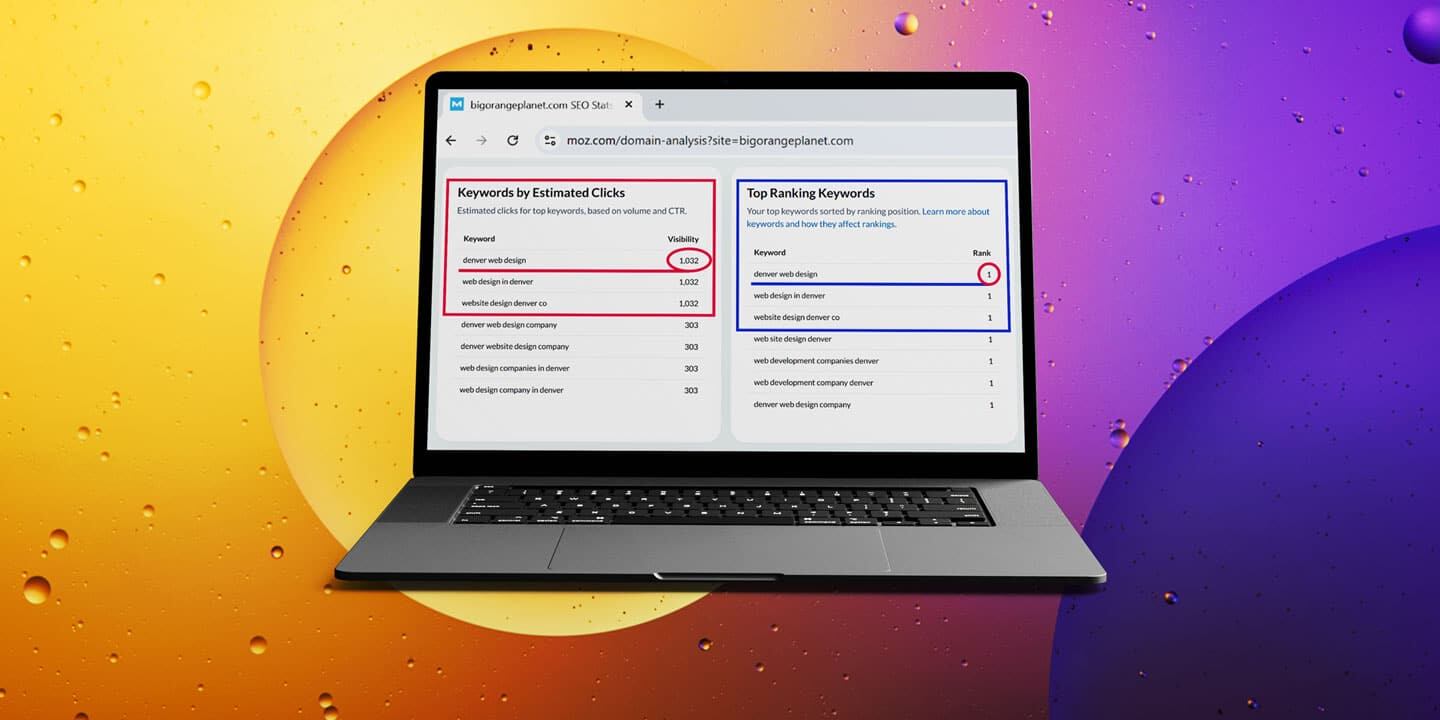
We Ranked #1 on Google for Competitive Keywords — Here’s How
We reached #1 on Google for a cluster of Denver web design and development…

May 29, 2026
Why Google Stops Trusting Websites (And How to Earn That Trust Back)
Google search results are shifting across industries, keyword clusters, and…

May 17, 2026
How Proximity Impacts Local Rankings in Google Search
The Big Orange Planet JournalSEO
Proximity is one of the biggest factors affecting local Google rankings. We…

April 3, 2026
How to Rank in Denver Search Results (When Rankings Won’t Sit Still)
Google search results are shifting across industries, keyword clusters, and…