
Web Design for Mountain Town Businesses in Colorado
Building a website for a Colorado mountain-town business comes with a few challenges that don’t necessarily show up when you’re building a site for a business in Denver. The audience can be different, the seasons can matter, the geography can be complicated, and in some communities a business may be trying to reach both year-round residents and people who are only there for a few days.
That doesn’t mean mountain-town businesses need some completely different kind of website. It means the website needs to understand the market. A good site should make it immediately clear what the company does, where it operates, who it serves and why someone should choose it. Everything else — design, technology, SEO, photography, content and functionality — should support that.
That’s particularly important in Colorado, where a business in a mountain community may be competing for attention from local residents, seasonal visitors, second-home owners, people planning trips months in advance and customers searching from somewhere else entirely. The website has to work for the people who already know the town as well as the people who are just discovering it. That’s the same philosophy we use across our Big Orange Planet website design and SEO work throughout Colorado.
Mountain Town Businesses Have a Different Audience
One of the first things I look at with a mountain-town website is who is actually using it. That’s not always as simple as identifying the people who live there.
A local restaurant may primarily want visitors searching for somewhere to eat tonight. A real estate company may be talking to buyers who live hundreds or thousands of miles away. A contractor might serve permanent residents as well as second-home owners. A property-management company could be dealing with homeowners who live somewhere else entirely. A guide, outfitter or tourism business may have almost no local customers during its busiest season.
Those audiences have different questions. Someone who lives in the community may already know where you are, while a visitor may need directions, parking information, hours and a clear explanation of what you offer. Someone considering relocating may want information about the community itself before contacting a real estate agent. A second-home owner looking for a contractor may be much more interested in reliability, availability and service area.
The website should anticipate those differences rather than forcing every visitor through exactly the same path.
Local Information Can Be Part of the Value
Mountain businesses have an interesting opportunity because the location itself can be part of the reason someone is interested in the company. That doesn’t mean filling a website with generic descriptions about how beautiful Colorado is. There are plenty of those already.
It means providing information that is genuinely useful to the people you’re trying to reach. A real estate website might explain different neighborhoods or areas. A contractor might explain what homeowners need to consider when building or remodeling at elevation. A tourism business might provide practical information about seasons, access, activities or local conditions.
That kind of content can do two jobs at once. It helps a potential customer make a decision, and it gives search engines more useful information about the business and the community it serves.
That’s part of the broader philosophy behind our Colorado web design and development approach. The website shouldn’t simply announce that a business exists. It should help explain what the business does and why it matters in its particular market.
Seasonality Changes the Website
Seasonality is another major consideration.
A mountain business may have a dramatic difference between winter and summer. Some businesses have two completely different customer bases depending on the season. Others have a busy season followed by months when they’re primarily serving locals or preparing for the next cycle.
The website doesn’t necessarily need to change dramatically every season, but it should be designed with that reality in mind. Important seasonal services should be easy to find. Hours and availability should be clear. Promotions shouldn’t remain on the site long after they’ve expired. And if the business depends heavily on advance bookings, the path from search result to reservation needs to be as simple as possible.
This is also where good content planning matters. A business doesn’t necessarily need to publish endless seasonal articles. A smaller number of useful, well-maintained pages can be much more valuable than a large collection of thin content that nobody updates.
Local SEO Gets More Complicated
Local SEO is particularly interesting in mountain communities because the physical geography can be a bigger factor than it is in a dense urban market.
A business may serve several nearby communities even though its physical address is in only one of them. A contractor might travel a considerable distance for projects. A real estate company might cover an entire valley. A tourism business might attract customers who are searching long before they ever reach Colorado.
That means you need to distinguish between where the business is located and where the business actually serves customers.
Trying to create a separate page for every nearby town simply because the town name has search volume isn’t necessarily a good strategy. Those pages need to provide real value and accurately represent the company’s service area. Otherwise, you can end up with a website full of nearly identical location pages that don’t help either customers or search engines. That’s one of the issues we discuss in more detail in Local SEO Mistakes That Cost You Leads.
The same principle applies to Google Business Profile and other local business information. The business’s name, address, phone number, service area and other important details should be consistent and accurate across the web.
The Website Needs to Work on a Phone
This sounds obvious in 2026, but it’s especially important for businesses that depend on visitors.
Someone searching for a restaurant, lodging company, guide, outfitter or repair service may be doing it from their phone while they’re already in the area. They don’t want to pinch and zoom their way around a desktop website that was squeezed onto a mobile screen.
Important information should be easy to find. Phone numbers should work. Maps and directions should be useful. Forms should be simple. Menus, schedules, availability and booking information shouldn’t require a scavenger hunt.
A website can be visually beautiful and still be frustrating to use. For a local business, that friction can mean someone simply goes back to Google and chooses another company. That’s one reason we treat usability and search as part of the same website conversation, rather than treating design and SEO as completely separate projects.
Photography Matters More Than People Think
Mountain-town businesses also have an advantage when it comes to visual storytelling. Colorado provides some pretty spectacular subject matter.
But there is a difference between using attractive Colorado photography and showing the actual business.
If you’re a real estate company, people need to see the properties and understand the areas you’re serving. If you’re a restaurant, show the restaurant and the food. If you’re a contractor, show completed work. If you’re an outfitter or guide, show what the actual experience looks like. Stock photos of generic mountains may look nice, but they don’t necessarily establish much credibility.
The website should make the business feel real.
That’s particularly important when you’re trying to reach someone who isn’t local. If a potential customer is researching your company from another state, the website may be one of the few opportunities you have to establish trust before they ever speak with you.
Real Estate Is a Good Example
Real estate provides a particularly good example of why mountain-town websites need to be built around the actual customer journey.
Someone looking for a home in a Colorado mountain community may begin with a very broad search. They may be researching the community, comparing neighborhoods, looking at property values, considering recreation and amenities, or simply trying to understand what it would be like to live there.
The website can support that research.
Property search is obviously important, but it shouldn’t necessarily be the entire website. Community information, relocation resources, neighborhood information, market explanations and useful answers to common questions can all help a buyer understand the area before they’re ready to talk to an agent.
We’ve seen a similar principle work with real estate websites outside the mountain market as well. The website has to serve the person who is still researching, not just the person who is ready to fill out a contact form.
Don’t Turn the Website Into a Tourism Brochure
There’s an interesting trap here, particularly for businesses located in popular destinations.
Because the town itself is a destination, it can be tempting to fill the website with information about skiing, hiking, restaurants, festivals and things to do. Some of that can be useful, but the business still needs to be the center of the website.
If you’re a real estate company, the site ultimately needs to help people with real estate. If you’re a contractor, it needs to explain your construction or remodeling services. If you’re a restaurant, it needs to help people understand the restaurant.
Local content should support the business rather than replace it.
That’s an important distinction because the goal isn’t simply to attract traffic. The goal is to attract the right traffic.
Content Should Answer Real Questions
This is where I think mountain-town businesses can do some particularly useful SEO without resorting to the usual keyword-stuffing approach.
Think about the questions customers actually ask.
How much does it cost to build here? What’s the difference between two nearby communities? When is the busiest season? Do you serve a particular area? What happens when the weather changes? How far do you travel for a project? What should someone know before buying a second home? What does it take to maintain a property when the owner lives out of state?
Those are real questions. If your business can answer them accurately and clearly, you’ve created something more useful than another generic “Top Things to Do in Colorado” article.
This is also where a well-organized content structure becomes important. Related articles should connect to relevant service pages, location information and other useful resources. The result is a website that gives visitors a clearer picture of the business while building a stronger body of relevant information around it. Our article on internal linking and SEO goes deeper into why those relationships matter.
AI Search Makes Clarity Even More Important
There’s another reason I like this approach. Search is no longer limited to the traditional ten blue links.
People are increasingly asking AI systems questions about businesses, communities, services and destinations. Those systems need understandable information to work with. A website that clearly explains what a company does, where it operates, what services it provides and what makes it different gives those systems considerably more useful information than a website built primarily around vague marketing language.
That doesn’t mean a mountain-town business needs to create an “AI SEO” website. It means the fundamentals matter even more: accurate information, clear structure, useful content, recognizable business information and a website that makes sense to a human reader.
Build for the Business, Not Just the Destination
A mountain-town website should reflect its surroundings, but it shouldn’t get lost in them.
The mountains can be part of the story. The community can be part of the story. Seasonal changes, local customers and visitors can all be part of the story. But the website still needs to make the business clear enough that a visitor knows what you do, whether you can help them and what they should do next.
That’s the balance I’d look for in a Colorado mountain-town website: enough local relevance to make the business visible in its market, enough useful information to establish credibility, and enough focus on the actual business to turn visitors into customers.
The technology behind the site can vary. WordPress may make sense. Custom development may make sense. A simpler solution may be perfectly appropriate for another business. The important thing is that the technology, design, content and SEO strategy all support the same objective. For businesses specifically evaluating their options, our Denver web design and development services provide a useful example of how we approach that work.
A mountain-town business doesn’t need to look like every other Colorado website.
It needs to look like that business, in that place, serving those customers.
Big Orange Planet is a Denver web design and development company serving businesses throughout Colorado.
Get the Good Stuff
No fluff. Just practical web design ideas, SEO insight, behind-the-scenes projects, & solutions we've tested in the real world.
Never Miss a Good Idea
More Big Orange Knowledge

September 5, 2026
What Happens When Your Website Goes Down? The Hosting Problems Most Businesses Never Think About
When a website goes down, the problem isn't always the website. Hosting, DNS,…

May 29, 2026
Why Furnished Interior Presentation Matters in Colorado Residential Developments
Discover how AI is revolutionizing web design — from smart automation and…

April 26, 2023
Web Design Trends: What’s Actually Changing — and What Still Matters
Web design changes constantly, but not every trend matters. Here's what is…

May 5, 2026
Web Design That Performs: How to Build Sites That Look Great and Actually Convert
Because there are so many providers that offer access to the hosting plans, you…

April 13, 2026
How Website Design Impacts SEO Rankings (Complete Guide)
Google search results are shifting across industries, keyword clusters, and…
September 28, 2026
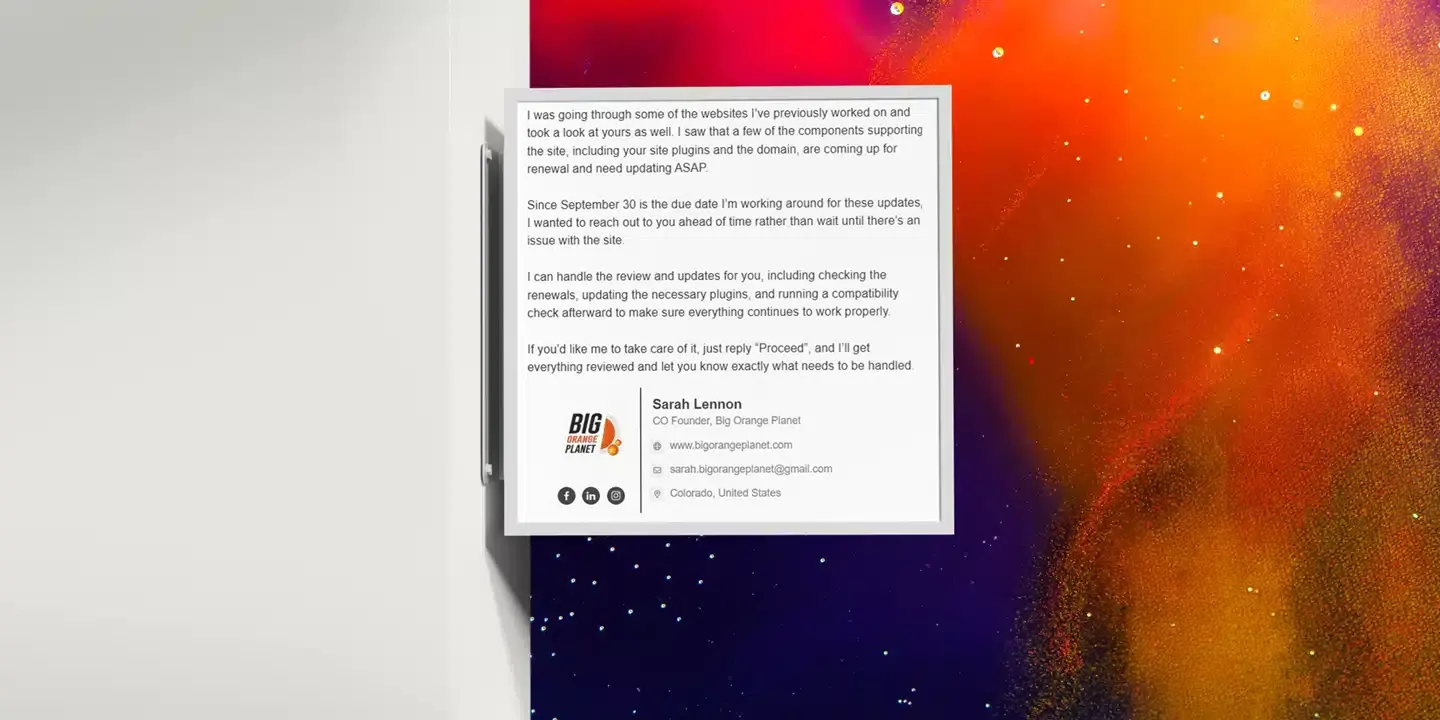
The New Phishing Attack Doesn’t Look Like Spam — It Looks Like Someone You Know
Phishing isn't always an obvious scam anymore. We recently saw an attack that…