
Being a Good Web Designer Doesn’t Automatically Make You a Good Freelance Web Design Business Owner
There is a big difference between knowing how to build a website and knowing how to make a living building websites. It’s a distinction that catches a lot of new freelance web designers off guard. You can understand HTML, CSS, JavaScript, WordPress, responsive design, and all the other technical pieces of the job and still struggle to find clients, price projects, manage expectations, or make enough money to keep the business going.
That’s because freelance web design is two businesses operating at the same time. One is the actual design and development work. The other is everything required to sell that work, deliver it professionally, collect payment, and convince clients that hiring you was the right decision.
The technical side is often the part new designers enjoy most. Unfortunately, it isn’t necessarily the part that determines whether their freelance business survives. If you’re thinking about starting out on your own, there are a few realities worth understanding before you start chasing your first client.
Your Portfolio Needs to Demonstrate More Than Design Skills
A portfolio is usually the first thing a prospective client wants to see. New designers often approach it as an opportunity to show off their creativity, technical skills, and understanding of current design trends. Those things matter, but they’re not necessarily what a business owner is looking for.
A business owner wants to know whether you can build something that works for their business. Can you organize information so visitors understand what the company does? Can you create a professional appearance that builds confidence? Can you make the website easy to navigate? Does the finished product give visitors a reason to contact the company or make a purchase?
Those are considerably more important questions than whether you can create an impressive animation or reproduce the latest design trend.
If you don’t have paying clients yet, you can still build a meaningful portfolio. Create a few complete projects for fictional businesses, redesign an existing website as a concept exercise, or offer your services to a local organization that needs help. The important thing is to approach these projects as real business assignments rather than isolated design exercises.
Explain what you were trying to accomplish, why you made particular design decisions, and how the finished website addresses the needs of its intended audience. A portfolio with three thoughtful, complete projects can make a much stronger impression than one containing fifteen unrelated experiments.
Finding Clients Is a Different Skill From Finding Design Inspiration
This is where many new freelancers discover that the business side of web design is considerably harder than they expected.
When you’re learning web design, there is always something to work on. You can improve your skills, experiment with layouts, learn new tools, and build another project. Finding someone willing to pay you to do those things is an entirely different challenge.
Your first instinct might be to create a website advertising your services and wait for inquiries. That’s certainly worth doing, but a new freelance designer shouldn’t expect a website alone to generate a steady stream of business. You have no established reputation, no meaningful client history, and probably very little visibility in search results.
You need to become more deliberate about finding opportunities.
Start with people and businesses you can actually reach. Local businesses often have outdated websites, confusing navigation, poor mobile experiences, or websites that simply don’t communicate what they offer very well. That doesn’t mean you should approach every business owner with an unsolicited list of everything wrong with their website. It means you should learn to recognize genuine opportunities and explain how you could improve them.
Personal referrals can be particularly valuable when you’re starting out. Friends, family members, former colleagues, business owners you know, and professional contacts can all become sources of introductions. You don’t need to turn every conversation into a sales pitch, but people should know what you do and the types of projects you’re interested in taking on.
You can also establish relationships with marketing consultants, copywriters, photographers, branding professionals, and other freelancers whose clients may need web design services. These relationships can eventually become a more dependable source of projects than constantly searching for individual clients.
The point is simple: finding clients is part of the job. It doesn’t happen automatically because you know how to build a good website.
Stop Pricing Projects Based on How Long They Take You
Pricing is one of the biggest mistakes new freelance designers make. It’s tempting to estimate how many hours a website will take, multiply that by an hourly rate, and present the result as a project price.
The problem is that the actual design and development work is only one part of delivering a website.
There are initial conversations, research, planning, proposals, revisions, content questions, testing, client meetings, launch preparation, and administrative work. Some projects also involve unexpected technical problems or clients who take considerably longer than anticipated to make decisions.
If you price a project based exclusively on the time you expect to spend designing it, you may discover that you’re earning far less than you thought.
Before quoting a project, understand exactly what the client expects. How many pages are involved? Who is providing the content? Is the website being built from scratch or using an existing platform? Are custom features required? Who is responsible for hosting, maintenance, and ongoing updates?
You should also understand what is not included.
A client asking for a website may assume that writing the content, creating a logo, optimizing search visibility, sourcing photography, setting up email, and providing ongoing technical support are all part of the same package. Unless you establish boundaries, those expectations can quickly turn a reasonably priced project into an unprofitable one.
Don’t be afraid to charge appropriately for your work. Being new doesn’t mean your time has no value. At the same time, you need to be realistic about your experience, the market you’re serving, and the value you’re actually delivering.
The objective isn’t to win every project by being the cheapest designer available. It’s to build a business that can support the time and effort required to do good work.
For perspective, look at how established web design companies structure their services and project pricing. Understanding what goes into a professional website project can help you develop a more realistic approach to estimating your own work. Here’s an example of how web design pricing and project services are structured.
Learn to Manage Clients Before You Need to Manage Problems
Working with clients is an acquired skill, and it’s one that can have a bigger impact on your freelance career than your choice of design software.
Clients generally aren’t web designers. They may have a clear idea of what they want their website to accomplish, but they often have difficulty explaining how that should translate into an actual design. Some will arrive with a collection of websites they like. Others will describe something they saw on a competitor’s website and ask you to reproduce it.
Your job is to listen, understand the underlying objective, and help translate their ideas into something practical.
That doesn’t mean agreeing with every suggestion. A client might request a feature that makes the website harder to use or insist on a design choice that conflicts with the company’s brand. You need to be comfortable explaining why you recommend a different approach.
This requires communication, patience, and the ability to explain technical and design decisions without making clients feel foolish for asking questions.
It also requires setting expectations before work begins. Put the project scope in writing. Establish how feedback will be handled, how many revision rounds are included, what the client needs to provide, and when payments are due.
A written agreement isn’t about expecting every client to become difficult. It’s about making sure everyone understands what they’re agreeing to.
One of the most valuable lessons a freelance designer can learn is that a good client relationship doesn’t mean saying yes to everything. It means delivering what was agreed upon, communicating honestly, and dealing with problems before they become expensive.
Your Process Is Part of What Clients Are Paying For
A professional web design experience should feel organized from the first conversation through the final launch.
New freelancers sometimes approach every project as though it’s a completely new adventure. They improvise the process, figure things out as they go, and rely on memory to keep track of decisions and outstanding tasks.
That might work for a small project or two. It becomes increasingly difficult as the number of clients grows.
Develop a repeatable process. Start with an initial discovery conversation, followed by a proposal that clearly outlines the work. Establish the project requirements, collect the necessary content and assets, and agree on the major milestones before development begins.
Keep clients informed as the project progresses. They don’t need a daily technical report, but they should never have to wonder whether anything is happening.
You should also create standard documents and procedures for recurring tasks. Proposals, contracts, onboarding questions, content requests, feedback instructions, launch checklists, and maintenance agreements are all worth standardizing.
Templates and automation can save considerable time, but they should support your process rather than replace personal communication.
The more predictable your process becomes, the easier it is to estimate projects, manage multiple clients, and deliver consistent results.
Even the final handoff deserves a consistent process. A website isn’t finished simply because the design has been approved. Forms, mobile layouts, integrations, redirects, analytics, and client access all need to be checked. Our website handoff checklist covers many of the details that are easy to overlook.
A Website Launch Shouldn’t Be the End of the Relationship
One of the least understood aspects of freelance web design is what happens after a website goes live.
Many new designers focus almost entirely on getting the initial project. They complete the website, receive the final payment, and immediately start looking for the next client.
That approach leaves a significant business opportunity unexplored.
Websites require ongoing attention. Software needs updating, backups need monitoring, security needs to be maintained, content changes, and businesses evolve. Clients may also need help with hosting, performance, analytics, search engine optimization, and additional functionality.
You don’t have to offer every service yourself. You do, however, need to understand which services your clients may need and how you can continue helping them after launch.
Website maintenance agreements are one way to establish recurring revenue. Rather than treating every small update as a separate sales opportunity, you can offer clients an ongoing service that covers agreed-upon maintenance and support.
You can also develop relationships with professionals who provide complementary services, such as SEO, content development, photography, and digital marketing.
This changes the economics of freelancing. Instead of constantly starting from zero with every new project, you gradually build a client base that can generate repeat work and ongoing revenue.
A successful freelance business isn’t necessarily the one building the most websites. It’s the one building sustainable relationships and delivering value beyond the initial project.
Keep Learning, But Don’t Chase Every New Technology
Web design changes constantly. New frameworks, development tools, content management systems, design approaches, and AI-powered services appear at a pace that can make it feel as though you’re always falling behind.
You do need to keep learning. But there’s a difference between improving your capabilities and chasing every new technology simply because it’s available.
Strong fundamentals remain valuable. Understanding user experience, responsive design, accessibility, website architecture, performance, and the relationship between design and business objectives will serve you across different platforms and technologies.
You should also develop an understanding of the disciplines surrounding web design. Basic knowledge of search engine optimization, conversion principles, branding, content strategy, and analytics can make you considerably more useful to clients.
AI is changing the way websites are planned, designed, developed, and maintained. It can help freelancers work more efficiently, explore ideas, and automate certain tasks. But access to AI tools doesn’t automatically create business judgment or professional experience.
Clients still need someone who can understand their objectives, make informed decisions, recognize problems, and take responsibility for the finished product.
Technology will continue changing. The ability to solve problems for clients is a much more durable skill.
If you’re interested in the broader services that can complement web design, take a look at the range of services involved in building and growing a business’s online presence.
Build a Business, Not Just a Collection of Projects
Freelance web design can be a rewarding career. You have the opportunity to work independently, choose the types of projects you pursue, develop your skills, and build relationships with businesses that need your help.
But independence comes with responsibility. You’re not just the designer anymore. You’re also responsible for finding work, managing finances, communicating with clients, setting expectations, delivering projects, and planning for what comes next.
Those responsibilities aren’t distractions from web design. They’re what make it possible to earn a living doing it.
Start with manageable projects. Build a portfolio that demonstrates practical ability. Learn how to price your work, communicate professionally, and establish a process that you can repeat. Pay attention to the business problems your clients are trying to solve, not just the appearance of the websites they’re asking you to build.
Most importantly, don’t measure your progress exclusively by the number of websites you’ve completed. Measure it by the quality of the work, the relationships you’re building, the experience you’re gaining, and whether you’re creating a business that can support you over the long term.
Being a capable web designer is a good starting point. Learning how to run a web design business is what turns that ability into a career.
And if you want to see how an established web design company approaches real-world projects, you can explore the Big Orange Planet portfolio for examples of websites, branding, and development work across different industries.
More Big Orange Knowledge

May 4, 2026
From Legal to Marketing: Key Consulting Services for Businesses
Because there are so many providers that offer access to the hosting plans, you…

September 5, 2026
What Happens When Your Website Goes Down? The Hosting Problems Most Businesses Never Think About
When a website goes down, the problem isn't always the website. Hosting, DNS,…
September 28, 2026
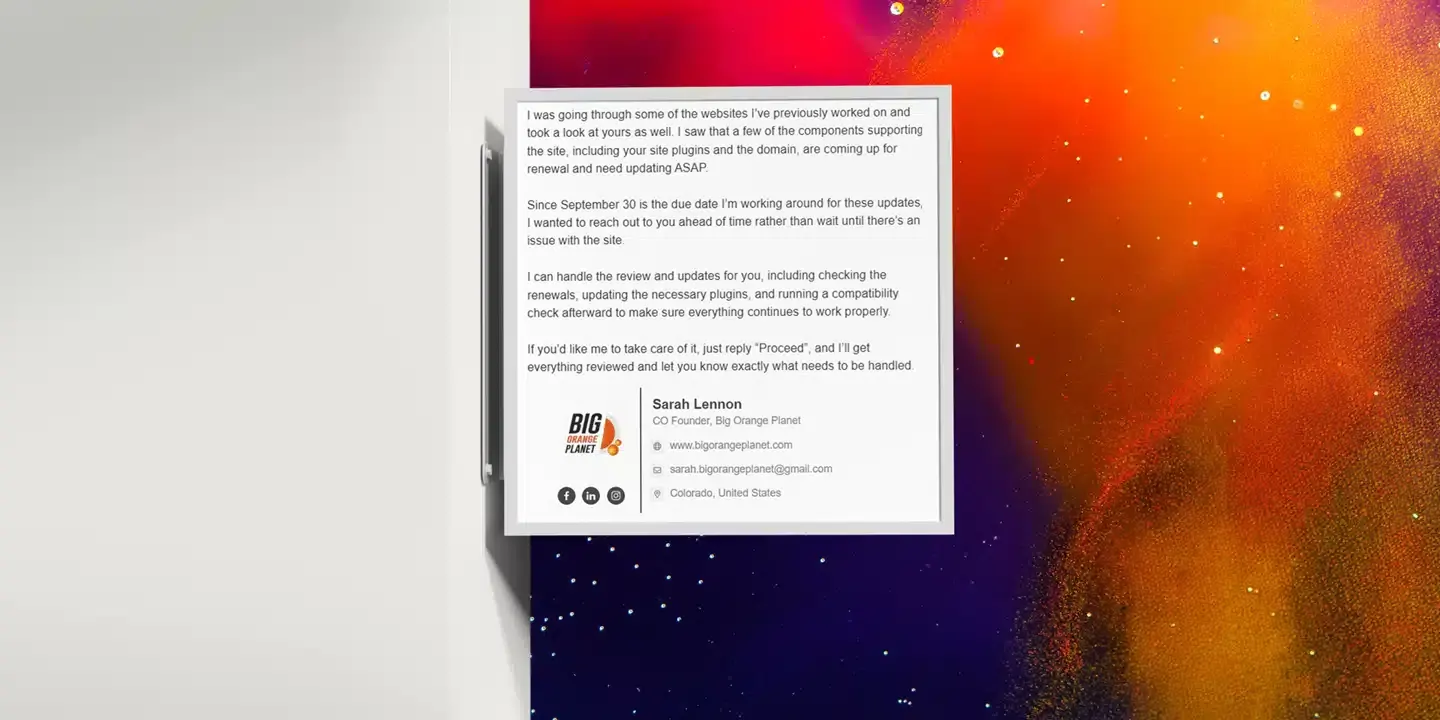
The New Phishing Attack Doesn’t Look Like Spam — It Looks Like Someone You Know
Phishing isn't always an obvious scam anymore. We recently saw an attack that…

June 7, 2026
What Makes A Website Feel Expensive?
Some websites instantly feel polished, credible and expensive while others…

May 18, 2026
Web Design for Mountain Town Businesses in Colorado
Colorado mountain-town businesses face a different web design challenge. Learn…

May 5, 2026
Web Design That Performs: How to Build Sites That Look Great and Actually Convert
Because there are so many providers that offer access to the hosting plans, you…